
2.1 Demand Function: Types, Determinants of Demand, and Movement & Shift in Demand Curve
… Hey there! Welcome to the first lesson of Unit 2. In this lesson, we will be covering Demand Function: Types, Determinants of Demand, and Movement & Shift in Demand Curve. As usual, I ask you to carefully study all these notes and think aloud or write down what you’ve learnt for effective memory. So, let’s get started.


हुन्छ Sir …..अब सुरू गरिहालौं!
Group A – Brief Answer Questions
Chapterwise Notes in Q & A Format for Group A ( with TU Soln )
Demand Function: Types, Determinants of Demand, Movement & Shift in Demand Curve
Q) What is meant by demand?
→ In microeconomics, demand refers to the amount of a good or service that consumers are willing and able to purchase at a certain price during a specific period of time. The quantity of a good or service demanded by consumers is usually inversely related to its price, meaning that as the price of a good or service increases, the quantity demanded typically decreases, and vice versa. This relationship is known as the law of demand.
Q) Define demand function.
→ Demand function is a functional relationship between the demand for a certain good and the various factors affecting that good’s demand. The various factors affecting the demand of any good (i.e. the determinants of demand) are price of the good, price of the related goods, income of the consumer, taste and preference of the consumer, the population size and its composition, and the advertisement expenditure.
Demand function is typically expressed as:
Dx = f (Px, Pr, Y, T, P, A, …)
Where:
- Dx = Demand for a certain good i.e good X
- f = function
- Px = Price of good X
- Pr = Price of related goods
- Y = Income of the consumer (#TIP: Y को sound हल्का I संग मिल्ने भएकोले Y = I अर्थात् Income भन्ने सम्झने)
- T = Taste and preference of the consumer
- P = Population size and its composition
- A = Advertisement expenditure
Q) Define linear demand function.
→ In microeconomics, a demand function is said to be linear when the slope of the demand function remains constant throughout its length.
The equation for a linear demand function can be expressed as Qdx= a – bPx, where:
- Qdx is the Quantity demanded of the good X
- Px is the price of the good X
- a is the autonomous demand
- b is the slope of the demand curve
Q) Define non linear demand function.
→ In microeconomics, a demand function is said to be non-linear when the slope of the demand curve changes throughout its length.
The equation for a non-linear demand function can be expressed as: Qdx = a(Px)-b ,where:
- Qdx is the Quantity demanded of good X
- a = autonomous demand
- Px = the Price of good X
- b = slope of the demand curve
Q) List out any five determinants of demand. [2072 Q.No.2]
→The most important determinants of demand are:
- Price of the good or service
- Income of the consumer
- Price of RELATED goods
- Consumer tastes and preferences
- Population size and its composition
Understanding these determinants is important for businesses and policymakers to effectively manage demand and supply in the market.
#माथिको question संग हल्का related question हरु:
Q) What are the causes of increase in demand?
→ An increase in demand can be caused by changes in consumer income, tastes and preferences, population growth, introduction of new products, increase in advertising and promotion, change in consumer expectations, and availability of credit.
Q) What are the causes of decrease in demand?
→ A decrease in demand can be caused by a decrease in consumer income, changes in tastes and preferences, population decline, introduction of new substitutes, increase in price of complementary goods, change in consumer expectations, and economic recession, etc.
Q) What is meant by movement along a demand curve?
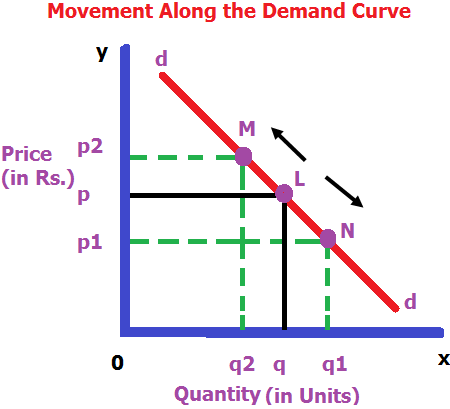
→ Movement along a demand curve refers to the change in the quantity demanded of a commodity due to a change in its price ( assuming that all other factors such as income & preference of the consumers, and prices of related goods remain constant).
बुझ्नको लागि मात्रै |
#Figure Explanation:
- When Price rises from OP to OP2, Quantity Demanded falls from OQ to OQ2. This is known as Contraction of Demand.
- When Price falls from OP to OP1, Quantity Demanded rises from OQ to OQ1. This is known as expansion of Demand.
Q) What is meant by extension in demand?
→ Extension in demand refers to an increase in the quantity demanded of a good or service due to a decrease in its price, while other factors such as income, tastes, and prices of related goods remain constant. This means that as the price of a good decreases, consumers are willing to buy more of it, leading to an extension or expansion in the quantity demanded.
→ This relationship between price and quantity demanded is represented by the downward-sloping demand curve, which illustrates that at lower prices, consumers are willing to buy more of a good or service, while at higher prices, they are willing to buy less of it.
(See the figure explanation above from the earlier question for further clarity)
Q) What is meant by contraction in demand?
→ Contraction in demand refers to a decrease in the quantity demanded of a good or service due to an increase in its price, while other factors such as income, tastes, and prices of related goods remain constant. This means that as the price of a good increases, consumers are willing to buy less of it, leading to a contraction or reduction in the quantity demanded.
→ This relationship between price and quantity demanded is represented by the downward-sloping demand curve, which illustrates that at lower prices, consumers are willing to buy more of a good or service, while at higher prices, they are willing to buy less of it.
(See the figure explanation above from the earlier question for further clarity)
Q) What is meant by shift in demand curve?
→ A shift in the demand curve refers to a change in the quantity demanded of a good or service at every price point.
The factors that can cause a shift in the demand curve include changes in consumer preferences, changes in income, changes in the prices of related goods (substitutes or complements), changes in population, and changes in advertising or marketing campaigns.
When any of these factors change, it can cause consumers to demand more or less of a good or service at every price point, which results in a shift in the demand curve.
Q) What is the difference between movement along a demand curve and the shift in a demand curve?
→ Movement along a demand curve refers to a change in the quantity demanded of a good or service due to a change in its price whereas a shift in demand curve refers to a change in the quantity demanded of a good or service due to a change in one or more of the factors that influence demand (e.g. consumer income, tastes and preferences, etc), other than its price.
#जाँदाजाँदै एकैछिन चिया, coffee, पेट्रोल अनि गाडीको पनि कुरा गरि हालम्नत 🙂
What happens to demand for tea when the price of coffee rises?The demand for tea will rise when the price of coffee rises. This is because coffee is a substitute good for tea and when it is expensive, people will start moving toward tea.
What happens to demand for petrol when the price of car falls?Petrol and car are considered complementary goods. Therefore, the demand for petrol will rise when the price of car falls and vice versa.
Brief Numerical Answer Questions
Group B – Descriptive Answer Questions
Chapterwise Notes in Q & A Format for Group B ( with TU Soln )
Demand Function and Its Types
Q) Describe the types of demand function [2078 Q.No.11]
OR
Q) What is demand function? Explain its types.
Definition of Demand Function
Demand function is a functional relationship between the demand for a certain good and the various factors affecting that good’s demand. The various factors affecting the demand of any good (i.e. the determinants of demand) are price of the good, price of the related goods, income of the consumer, taste and preference of the consumer, the population size and its composition, and the advertisement expenditure.
Demand function is typically expressed as:
Dx = f (Px, Pr, Y, T, P, A, …)
Where:
- Dx = Demand for a certain good i.e good X
- f = functional relationship
- Px = Price of good X
- Pr = Price of related goods
- Y = Income of the consumer (#TIP: Y को sound हल्का I संग मिल्ने भएकोले Y = I अर्थात् Income भन्ने सम्झने)
- T = Taste and preference of the consumer
- P = Population size and its composition
- A = Advertisement expenditure
Types of Demand Function
The demand function can be categorized into two types – linear and non-linear.
Linear demand function:
In microeconomics, a demand function is said to be linear when the slope of the demand function remains constant throughout its length.
The equation for a linear demand function can be expressed as:
Qdx= a – bPx, where:
- Qdx is the Quantity Demanded of the good X
- Px is the price of the good X
- a is the autonomous demand or the quantity demanded when the price is zero
- b is the slope of the demand curve
The figure for a linear demand function can be drawn as:
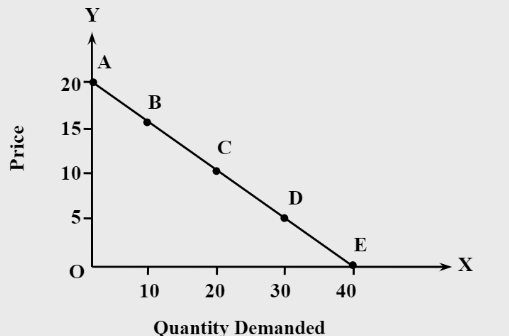
#In the figure, AE is the linear demand curve. It has a downward slope. And we can see that the slope remains constant throughout its length. Therefore, it represents the linear demand function.
Non linear demand function:
In microeconomics, a demand function is said to be non-linear when the slope of the demand curve changes throughout its length.
The equation for a non-linear demand function can be expressed as:
Qdx = a(Px)-b
where:
- Qdx is the Quantity demanded of good X
- a = autonomous demand
- Px = the Price of good X
- b = slope of the demand curve
The figure for a non-linear demand function can be drawn as:
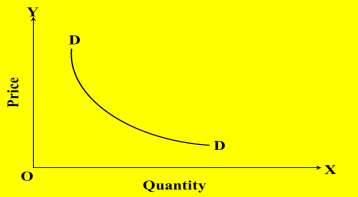
#In the figure, DD is the non-linear demand curve. It has a downward slope. And we can see that the slope changes throughout its length. Therefore, it represents the non-linear demand function.
Determinants of Demand
Q) Explain the various determinants of demand. [2074 Q.No.12]
OR
Q) Explain the major factors which influence the demand for a commodity. [2073 Q.No.11]
Determinants of Demand or Factors Affecting / Influencing Demand
The demand for any product or goods depends upon many factors. The factors that can affect the demand for goods in any market are known as the determinants of demand. Here are the ten major determinants of demand:
- Price of the product: When the price of a product decreases, the quantity demanded usually increases, and vice versa.
- Consumer income: If consumer income rises, they will typically demand more goods and services, and vice versa.
- Price of related goods: The demand for a product can be affected by the price of substitute goods (products that can be used instead) and complementary goods (products that are used together).
- Consumer tastes and preferences: If consumers’ tastes and preferences change in favor of a product, the demand for that product is likely to increase.
- Advertisement and marketing: The more a product is advertised, the more likely consumers are to demand it.
- Population and demographics: The size and age distribution of the population can affect the demand for goods and services.
- Availability of credit: When credit is easily available, consumers can afford to buy more goods and services, leading to an increase in demand.
- Consumer expectations: If consumers expect that the price of a product will rise in the future, they may demand more of it now.
- Weather conditions: Weather can affect the demand for goods and services, such as demand for air conditioning during hot weather.
- Government policies and regulations: Government policies such as taxes or subsidies can affect the demand for goods and services.
Movement along the Demand Curve and Shift in Demand Curve
Q) Explain the concept of movement along the demand curve and shift in demand curve.
Movement along the Demand Curve
Movement along the demand curve refers to the change in demand for a commodity due to the change in its price (assuming that all other factors remain constant).
For example, if the price of a product increases, the quantity demanded of that product typically decreases, and this results in an upward movement along the demand curve. This upward movement is known as the contraction in demand.
Similarly, if the price of a product decreases, the quantity demanded typically increases, and this results in a downward movement along the demand curve. This downward movement along the demand curve is known as the extension (expansion) in demand.
This concept of the movement along a demand curve can be better explained with the help of the following diagram.
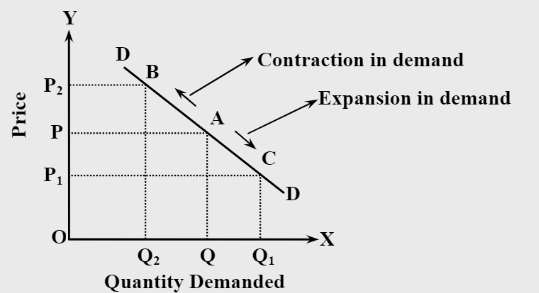
In the figure above, quantity demanded is measured along the X axis and price of the product along the Y axis. At the start, when price of the product is OP, the quantity demanded is OQ.
Now, when the price increases from OP to OP2, the quantity demanded decreases from OQ to OQ2. This is the contraction in demand.
Similarly, when the price decreases from OP to OP1, the quantity demanded increases from OQ to OQ1. This is the extension or expansion in demand.
Shift in Demand Curve
Shift in demand curve refers to a change in the quantity demanded of a product, due to a change in factors other than price ( price बाहेकको अरु factors मा आएको change ले गर्दा), assuming that price remains constant. Here, factors other than price refer to factors like income of the consumer, changes in taste and preference of the consumer, changes in the size and age distribution of the population, etc.
For example, if consumers’ incomes increase, they may demand more of a product at every price level, and this results in a shift of the demand curve to the right.
Conversely, if consumers’ incomes decrease, they may demand less of a product at every price level, and this results in a shift of the demand curve to the left.
This concept of the Shift in demand curve can be better explained with the help of the following diagram.
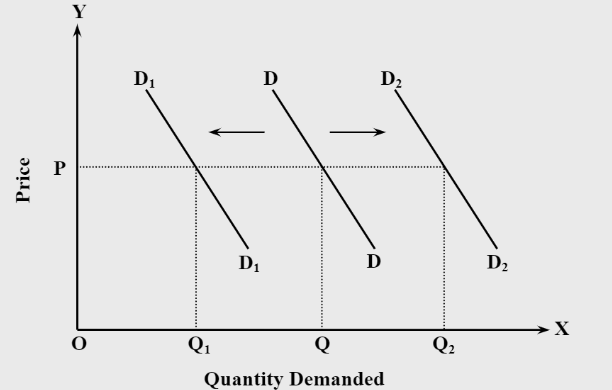
In the figure above, quantity demanded is measured along the X axis and price of the product along the Y axis. At the start, before the shift, we can see that DD is the original demand curve where OQ is the quantity demanded at OP price.
Now, when the quantity demanded increases from OQ to OQ2, there is a shift toward right in the original demand curve from DD to D2D2. This is called the rightward shift in the demand curve.
On the other hand, when the quantity demanded decreases from OQ to OQ1, there is a shift toward left in the original demand curve from DD to D1D1, at the same price level OP. This is called the leftward shift in the demand curve.
To summarize, movement along the demand curve is a result of a change in the price of a good or service, while shift in the demand curve is a result of a change in one or more factors other than price.
Q) Explain the differences between movement along the demand curve and shift in demand curve.
Differences between Movement along the Demand Curve & Shift in Demand Curve
The differences between movement along the demand curve and shift in demand curve are given below.
| Movement along the demand curve | Shift in demand curve |
|---|---|
| 1. It happens due to change in the price of goods only | 1. It takes place due to factors other than the price, such as changes in consumer income, preferences, population, advertising, and the prices of substitute or complementary goods. |
| 2. It is always shown along the same demand curve i.e. no new demand curve is drawn. | 2. A shift in the demand curve is shown as a shift of the entire curve to the left or right. |
| 3. Timeframe: Movement along the demand curve is a short-term phenomenon that reflects a change in the immediate price of the good or service. | 3. Timeframe: A shift in the demand curve reflects a longer-term change in the underlying factors that affect demand. |
| 4. It is also called change in quantity demanded | 4. It is also called change in demand. |
| 5. If the quantity demanded for a good increases due to decrease in pirce, the movement is called extension in demand. In this case, there is downward movement along the demand curve. | 5. If the demand for a good increases due to favorable changes in factors other than price, it is called increase in demand. In this case, there is a rightward shift in the demand curve. |
| 6. If the quantity demanded for a good decreases due to increase in price, the movement is called contraction in demand. In this case, there is upward movement along the demand curve. | 6. If the demand for a good decreases due to unfavorable changes in factors other than price, it is called decrease in demand. In this case, there is a leftward shift in the demand curve. |
| 7. Graphical Representation of Movement along the Demand Curve | 7. Graphical Representation of Shift in Demand Curve: |
Q) Explain the factors causing shift in demand curve.
Note: यो question को answer … एउटा factor बाहेक — त्यो अगाडिको ” Explain the determinants of demand/ Or, Explain the factors that influence demand” मा लेखे जसरिनै लेख्न सकिन्छ | So, please refer back to that question & write everything same except the “change in price” factor किनकि Shift in demand curve is caused due to change in factors other than prices ( price बाहेकको अरु factors मा आएको change ले गर्दा) |
Descriptive Numerical Answer Questions
Q) Suppose that a = 100 and b = 5, where ‘a’ is the autonomous demand and ‘b’ is the slope of the demand curve. Find out the demand function and quantity demanded at price Rs 4 and Rs 16. Derive the demand curve with the given data.
Solution
Given,
Autonomous demand (a) = 100
Slope of the demand curve (b) = 5
According to the formula, here demand function is given by:
Qdx = a – bPx
Substituting the values of a and b in the above equation, we have:
Qdx = 100 – 5Px
Now , according to the question, let’s find out the demand function and the quantity demanded at each price value.
Given Px = 4, we have Qdx = 100 -5 × 4 = 80
Given Px = 16, we have Qdx = 100 -5 × 16 = 20
Using the different price values given and the calculated quantity demanded at each price value, we can plot a linear demand curve as shown in the figure below.
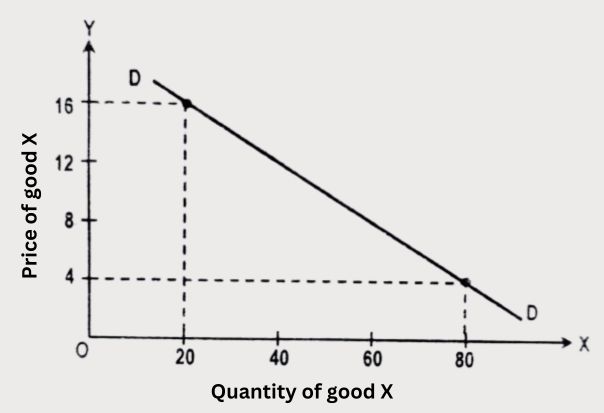
In the figure above, DD represents the linear demand curve.
Group C – Analytical Answer Questions
Chapterwise Notes in Q & A Format for Group C ( with TU Soln )
Possible Exam Q & A plus Past Exams Solution from this Group
Q) Define demand function. Explain the various determinants of demand. [2078 Q.No. 11]
Note: These question-topics are already discussed earlier in Group B. Please refer back to the Group for your answers.
Q) Explain the concept of shift in demand curve. Discuss the factors responsible for shift in demand curve.
Note: These question-topics are already discussed earlier in Group B. Please refer back to the Group for your answers.

Congratulations! You’ve now gone through every type of question that can be asked in your exams from this unit. A next round of revision will certainly help you learn & remember all these answers to your exam questions!