
2.2 Supply Function: Types, Determinants of Supply, and Movement & Shift in Supply Curve
… Hey there! Welcome to the second lesson of Unit 2. In this lesson, we will be covering Supply Function: Types, Determinants of Supply, and Movement & Shift in Supply Curve. As usual, I ask you to carefully study all these notes and think aloud or write down what you’ve learnt for effective memory. So, let’s get started.


हुन्छ Sir …..अब सुरू गरिहालौं!
Group A – Brief Answer Questions
Chapterwise Notes in Q & A Format for Group A ( with TU Soln )
Supply Function: Types, Determinants of Supply, and Movement & Shift in Supply Curve
Q) Define supply.
→ Supply is the amount of goods or services that producers are willing and able to sell at a given price and time.
.→ The law of supply states that as the price of a product increases, the quantity supplied of that product also increases, and vice versa.
Q) Define supply function.
→ Supply function is a mathematical equation that shows the relationship between the quantity of a good that producers are willing and able to supply at different prices, assuming all other factors are constant.
Q) Define linear supply function.
→ In microeconomics, a supply function is said to be linear when the slope of the supply curve remains constant throughout its length.
The equation for a linear supply function can be expressed as: Qsx= a + bPx, where:
- Qsx is the Quantity supplied of the good X
- Px is the Price of the good X
- a is the autonomous supply
- b is the slope of the supply curve.
Q) Define non-linear supply function.
→ In microeconomics, a supply function is said to be non-linear when the slope of the supply curve changes throughout its length.
The equation for a non-linear supply function can be expressed as: Qsx = a(Px)b , where
- Qsx = the Quantity supplied of good X
- a = autonomous supply or the quantity supplied when the price is zero
- Px = the Price of good X
- b = slope of the supply curve
Q) What is meant by extension in supply?
→ Other things remaining constant, extension in supply refers to an increase in the quantity of a product that producers are willing and able to supply in response to a change in the product’s price.
→ Extension in supply occurs when the price of a product increases, leading producers to offer more of that product for sale in the market. This is because producers can earn more revenue by selling more units of the product at a higher price. Extension in supply is a result of the positive relationship between price and quantity supplied, which is represented by the upward sloping supply curve.
Q) What is meant by contraction in supply?
→ Other things remaining constant, contraction in supply refers to a decrease in the quantity of a product that producers are willing and able to supply in response to a change in the product’s price.
→ Contraction in supply occurs when the price of a product decreases, leading producers to reduce the amount of that product they are willing to offer for sale in the market. This is because producers earn less revenue by selling fewer units of the product at a lower price. Contraction in supply is a result of the positive relationship between price and quantity supplied, which is represented by the upward sloping supply curve.
Q) List out the main causes of increase in supply.
#Note: 2 marks को question मा तलको points पछाडिको explanation आवश्यक पर्दैन, यो त just तपाईहरुलाई बुझ्न सजिलो होस् भनेर दिएको additional information मात्रै हो| Exam मा तपाईले आफुलाई सजिलो लाग्ने any 4 points मात्र लेखे पुग्छ |
→ The main causes of an increase in supply include:
- Decrease in the cost of production: If the cost of producing a product decreases, producers can offer more of the product for sale at each price level, leading to an increase in supply.
- Technological improvements: Advancements in technology can increase the efficiency and productivity of production, enabling producers to supply more of the product at a lower cost.
- Increase in the availability of raw materials: If the availability of raw materials increases, producers can produce more of the product, leading to an increase in supply.
- Increase in the number of suppliers: If more producers enter the market, the total supply of the product increases, leading to an increase in supply.
- Reduction in taxes and regulations: If taxes and regulations decrease, the cost of production decreases, leading to an increase in supply.
Q) List out the main causes of decrease in supply.
#Note: 2 marks को question मा तलको points पछाडिको explanation आवश्यक पर्दैन, यो त just तपाईहरुलाई बुझ्न सजिलो होस् भनेर दिएको additional information मात्रै हो| Exam मा तपाईले आफुलाई सजिलो लाग्ने any 4 points मात्र लेखे पुग्छ |
→ The main causes of a decrease in supply include:
- Increase in the cost of production: If the cost of producing a product increases, producers will be less willing and able to supply the product at each price level, leading to a decrease in supply.
- Technological setbacks: Technological setbacks can reduce the efficiency and productivity of production, making it more costly to produce the product, leading to a decrease in supply.
- Decrease in the availability of raw materials: If the availability of raw materials decreases, producers will be less able to produce the product, leading to a decrease in supply.
- Decrease in the number of suppliers: If fewer producers are in the market, the total supply of the product decreases, leading to a decrease in supply.
- Increase in taxes and regulations: If taxes and regulations increase, the cost of production increases, leading to a decrease in supply.
Q) What do you mean by shift in supply curve?
→ A shift in the supply curve refers to a change in the relationship between the price of a product and the quantity of that product that producers are willing and able to supply at each price level. A shift occurs when a non-price determinant of supply changes, such as a change in production costs, technology, or the number of suppliers, which causes the entire supply curve to shift to the left or right.
→ In contrast, a movement along the supply curve is caused by a change in the price of the product itself,all other things being equal, leading to a change in the quantity supplied.
Brief Numerical Answer Questions
Group B – Descriptive Answer Questions
Chapterwise Notes in Q & A Format for Group B ( with TU Soln )
Supply Function and Its Types
Q) Describe the types of supply function. [2077 Back Q.No.12]
OR
Q) What is supply function? Explain its types.
Definition of Supply Function
Supply function is the functional relationship between the supply of a certain good and the various factors affecting that good’s supply. The various factors affecting the demand of any good (i.e. the determinants of demand) are price of the good, price of the related goods, income of the consumer, taste and preference of the consumer, the population size and its composition, and the advertisement expenditure.
Supply function is typically expressed as:
Sx = f (Px, Py, Pf, T, G, N, …)
Where:
- Sx = Supply of a certain good i.e good X
- f = function
- Px = Price of good X
- Py = Price of good Y
- Y = Income of the consumer (#TIP: Y को sound हल्का I संग मिल्ने भएकोले Y = I अर्थात् Income भन्ने सम्झने)
- T = Technology (State of Technology)
- G = Goal of the producer
- N = Number of producers
Types of Supply Function
The supply function can be categorized into two types – linear and non-linear.
Linear supply function:
In microeconomics, a supply function is said to be linear when the slope of the supply curve remains constant throughout its length.
The equation for a linear supply function can be expressed as: Qsx= a + bPx, where:
- Qsx is the Quantity supplied of the good X
- Px is the Price of the good X
- a is the autonomous supply
- b is the slope of the supply curve.
Below is the figure showing a linear supply function.
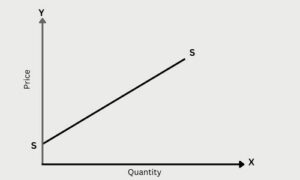
#In the figure, SS is the linear supply curve. It has an upward slope. And we can see that the slope remains constant throughout its length. Therefore, it represents the linear supply function.
Non linear Supply function:
In microeconomics, a supply function is said to be non-linear when the slope of the supply curve changes throughout its length.
The equation for a non-linear supply function can be expressed as: Qsx = a(Px)b , where
- Qsx = the Quantity supplied of good X
- a = autonomous supply
- Px = the Price of good X
- b = slope of the supply curve
Below is the figure showing a non-linear supply function.
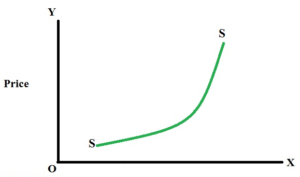
#In the figure, SS is the non-linear supply curve. It has an upward slope. And we can see that the slope changes throughout its length. Therefore, it represents the non-linear supply function.
Determinants of Supply
Q) Describe the determinants of supply. [2075 Q.No.12]
Determinants of Supply or Factors Affecting/Influencing Supply
The supply of any product or goods depends upon many factors. The factors that can affect the supply of goods in any market are known as the determinants of supply. Here are the ten major determinants of supply:
- Price of the product: A change in the price of the product itself will affect the supply of the product. If the price increases, producers will be willing to supply more of the product, whereas if the price decreases, they will be willing to supply less.
- Price of related goods: The supply of a product can also be affected by the price of related goods. If the price of a substitute good (a good that can be used in place of the original product) increases, the supply of the original product will increase, and if the price of a complementary good (a good that is consumed together with the original product) decreases, the supply of the original product will decrease.
- Production costs: The cost of producing a product can also affect its supply. If the cost of production increases, the supply of the product will decrease, and if the cost of production decreases, the supply of the product will increase.
- Technology: The level of technology used in producing a product can also affect its supply. If a new technology is developed that makes production more efficient, the supply of the product will increase, and if a technology becomes outdated or more costly, the supply will decrease.
- Government policies: Government policies can also affect the supply of a product. For example, subsidies can encourage production and increase supply, while taxes or regulations can discourage production and decrease supply.
- Number of suppliers: The number of suppliers in a market can also affect the supply of a product. If there are more suppliers, the supply will increase, and if there are fewer suppliers, the supply will decrease.
- Expectations of future prices: If producers expect prices to increase in the future, they may hold back some of their supply in order to sell at a higher price later. This will decrease current supply. If they expect prices to decrease in the future, they may increase current supply to avoid having to sell at a lower price later.
- Natural conditions: Natural conditions such as weather, natural disasters, or disease outbreaks can affect the supply of agricultural or natural resource-based products.
- Input prices: The prices of inputs such as labor, raw materials, and energy used in production can also affect the supply of a product.
- Market size: The size of the market can affect the supply of a product. If the market is large, producers may be more willing to increase their supply to capture a larger share of the market. If the market is small, producers may be less willing to increase their supply.
Movement along the Supply Curve and Shift in Supply Curve
Q) Explain the concepts of movement along the supply curve and shift in supply curve.
Movement along the Supply Curve
Movement along the supply curve refers to the change in supply of a commodity due to the change in its price (assuming that all other factors remain constant).
For example, if the price of a product increases, the quantity supplied of that product also increases, and this results in an upward movement along the supply curve. This upward movement is known as the expansion in supply (or, expansion of supply).
Similarly, if the price of a product decreases, the quantity supplied also typically decreases, and this results in a downward movement along the supply curve. This downward movement along the supply curve is known as the contraction in supply.
This concept of the movement along a supply curve can be better explained with the help of the following diagram.
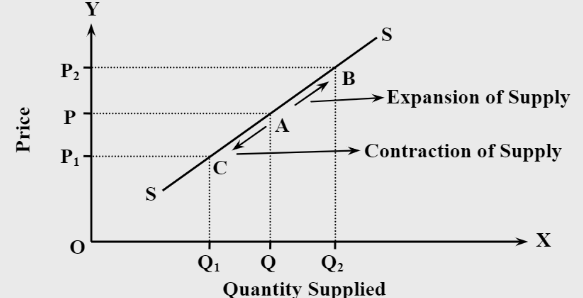
In the figure above, quantity supplied is measured along the X axis and price of the product along the Y axis. At the start, when price of the product is OP, the quantity supplied is OQ.
Now, when the price increases from OP to OP2, the quantity supplied also inecreases from OQ to OQ2. This is the extension or expansion in supply.
Similarly, when the price decreases from OP to OP1, the quantity supplied also decreases from OQ to OQ1. This is the contraction in supply.
Shift in Supply Curve
Shift in supply curve refers to a change in the quantity supplied of a product, due to a change in factors other than price ( price बाहेकको अरु factors मा आएको change ले गर्दा), assuming that price remains constant. Here, factors other than price refer to factors like cost of production, price of inputs, goal of the producer, number of producers, etc.
The shift in supply curve is of two types – the rightward shift in supply curve and the leftward shift in supply curve.
For example, due to favorable changes in factors other than price, there can be an increase in the supply of a product (i.e. more supply) at every price level, and this results in a shift of the supply curve to the right. This is known as the rightward shift in supply curve
Conversely, due to unfavorable changes in factors other than price, there can be a decrease in the supply of a product (i.e. less supply) at every price level, and this results in a shift of the supply curve to the left. This is known as the leftward shift in supply curve.
This concept of the rightward shift and the leftward shift in supply curve can be better explained with the help of the following diagram.
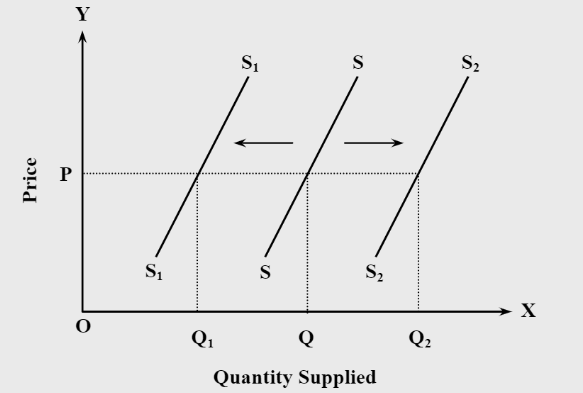
In the figure above, quantity supplied is measured along the X axis and price of the product along the Y axis. At the start, before the shift, we can see that SS is the original supply curve where OQ is the quantity supplied at OP price.
Now, when the quantity supplied increases from OQ to OQ2, there is a shift toward right in the original supply curve from SS to S2S2. This is called the rightward shift in the supply curve.
On the other hand, when the quantity supplied decreases from OQ to OQ1, there is a shift toward left in the original supply curve from SS to S1S1, at the same price level OP. This is called the leftward shift in the supply curve.
Q) Distinguish between movement along the supply curve and shift in the supply curve.
Differences between Movement along the Supply Curve & Shift in Supply Curve
The differences between movement along the supply curve and shift in supply curve are given below.
| Movement along the Supply Curve | Shift in Supply Curve |
|---|---|
| 1. It happens due to change in the price of goods only | 1. It takes place due to factors other than the price |
| 2. It is always shown along the same supply curve i.e. no new supply curve is drawn. | 2. A shift in the supply curve is shown drawing a new supply curve, either to the right or to the left of the original supply curve. |
| 3. It is also called change in quantity supplied | 3. It is also called change in supply. |
| 4. If the quantity supplied for a good increases due to increase in price, the movement is called extension in supply. In this case, there is upward movement along the supply curve. | 4. If the supply for a good increases due to favorable changes in factors other than price, it is called increase in supply. In this case, there is a rightward shift in the supply curve. |
| 5. If the quantity supplied for a good decreases due to decrease in price, the movement is called contraction in supply. In this case, there is downward movement along the supply curve. | 5. If the supply for a good decreases due to unfavorable changes in factors other than price, it is called decrease in supply. In this case, there is a leftward shift in the supply curve. |
| 6. Graphical Representation of Movement along the Supply Curve | 6. Graphical Representation of Movement along the Supply Curve |
Q) Explain the factors causing shift in supply curve.
Factors Causing Shift in Supply Curve
A shift in the supply curve takes place when the quantity supplied changes to either more supply or less supply. In case of more supply of a product, there is a rightward shift in the supply curve. On the other hand, in case of less supply of a product, there will be a leftward shift in the supply curve.
There are various factors that cause an increase or decrease in supply of a product, leading to a rightward shift or a leftward shift in the supply curve. The major factors are explained below.
➊ Production costs: If the cost of making a product goes up, producers will supply less of it, and the supply curve will shift to the left. If the cost of production goes down, producers will supply more of it, and the supply curve will shift to the right.
➋ Technology: If new technology makes it cheaper to produce a good or service, producers will supply more of it, and the supply curve will shift to the right. If new technology makes it more expensive to produce a good or service, producers will supply less of it, and the supply curve will shift to the left.
➌ Prices of related goods: If the price of a substitute or complementary good changes, producers may switch to producing more or less of a good or service, and the supply curve will shift accordingly.
➍ Number of sellers: If there are more sellers, producers will supply more of a good or service, and the supply curve will shift to the right. If there are fewer sellers, producers will supply less, and the supply curve will shift to the left.
➎ Expectations: If producers expect future prices to be higher, they may supply less now to take advantage of the higher price later, and the supply curve will shift to the left. If they expect future prices to be lower, they may supply more now, and the supply curve will shift to the right.
➏ Government policies: If the government imposes taxes or regulations that increase production costs, the supply curve will shift to the left. If the government provides subsidies or reduces regulations that lower production costs, the supply curve will shift to the right.
➐ Natural events: Natural events like weather or natural disasters can affect the supply of goods, and the supply curve can shift accordingly.
Overall, a shift in the supply curve happens when something changes and affects how much producers are willing to supply at each price level.
Descriptive Numerical Answer Question
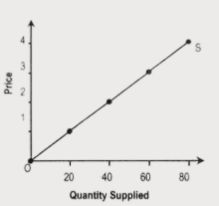
Q) Let supply function be Qsx = 20Px. Answer the questions given below.
a. Derive supply schedule.
b. Derive supply curve.
c. What factors are kept constant in the given supply function?
d. What is the minimum price that must be offered to this producer for the start of the supply?
e. State the nature of the supply curve.
Solution
a. The given supply function is Qsx = 20Px. If we assign different values to Px, we can have the following supply schedule.
| Price (Rs) | Quantity supplied (Qsx = 20Px) |
|---|---|
| 0 | 0 |
| 1 | 20 |
| 2 | 40 |
| 3 | 60 |
| 4 | 80 |
b. As we plot the combinations of price and quantity supplied from the above schedule, we get a supply curve as shown in the adjacent figure.
c. In the given supply function, factors such as price of related goods, price of factors of production, state of technology, number of firms, government policy, etc are kept constant.
d. Any price higher than zero will push the producer to start the supply of his products.
e. As the supply curve is a straight line, it represents the linear supply function.
Group C – Analytical Answer Questions
Chapterwise Notes in Q & A Format for Group C ( with TU Soln )
Possible Exam Q & A plus Past Exams Solution from this Group
Q) Define supply function. Discuss the various determinants of supply.
Note: These question-topics are already discussed earlier in Group B. Please refer back to the Group for your answers.
Q) Explain the concept of shift in supply curve. Discuss the factors responsible for shift in supply curve.
Note: These question-topics are already discussed earlier in Group B. Please refer back to the Group for your answers.

Congratulations! You’ve now gone through every type of question that can be asked in your exams from this unit. A next round of revision will certainly help you learn & remember all these answers to your exam questions!