
2.4 Market Efficiency || Measuring Market Efficiency by Consumer’s Surplus & Producer’s Surplus
… Hey there! Welcome to the final lesson of Unit 2. In this lesson, we will be covering Market Efficiency & Measuring Market Efficiency by Consumer’s Surplus and Producer’s Surplus. As usual, I ask you to carefully study all these notes and think aloud or write down what you’ve learnt for effective memory. So, let’s get started.


हुन्छ Sir …..अब सुरू गरिहालौं!
Group A – Brief Answer Questions
Chapterwise Notes in Q & A Format for Group A ( with TU Soln )
Concept of Market Efficiency || Measuring Market Efficiency by Consumer’s Surplus & Producer’s Surplus
Q) What do you mean by market efficiency?
Market efficiency is the situation where the maximum amount of goods and services are being produced with the most efficient organiztion of resources. In case of market efficiency, no additional output is possible without increasing the amount of inputs.
Q) What is surplus?
Surplus refers to the situation where quantity supplied becomes greater than the quantity demanded. It can also be referred to as excess supply.
Q) What is producer’s surplus?
The difference between the amount a seller obtains from the sale of goods and the cost of production is known as the producer’s surplus.
Group B – Descriptive Answer Questions
Chapterwise Notes in Q & A Format for Group B ( with TU Soln )
Concept of Market Efficiency & Measuring Market Efficiency by Consumer’s Surplus & Producer’s Surplus
Q) Define market efficiency. Discuss the way it is measured by consumer’s surplus and producer’s surplus.
What is Market Efficiency
Market efficiency is that state of the market in which goods are produced and consumed at the right quantities and prices, and resources are allocated in the most efficient way. This leads to the maximization of social welfare or total surplus, which is the sum of consumer surplus and producer surplus. (The opposite state of market efficiency is market inefficiency. In such state of market inefficiency, there may be overproduction or underproduction of goods and services, leading to a misallocation of resources and a reduction in social welfare.)
There are different types of market efficiency, such as allocative efficiency, which occurs when resources are allocated to their most productive uses, and productive efficiency, which occurs when goods are produced at the lowest possible cost.
Measuring Market Efficiency with the help of Total Surplus
Market efficiency is measured with the help of total surplus. This total surplus is the sum of consumer’s surplus and producer’s surplus. But what are consumer’s surplus and producer surplus? Lets understand this first.
Consumer surplus is the difference between the maximum price a consumer is willing to pay for a good or service and the actual price they pay. For example, imagine a person is willing to pay up to Rs 1000 for a concert ticket, but the ticket only costs Rs 800. In this case, the consumer enjoys a consumer surplus of Rs 200.
Producer surplus, on the other hand, is the difference between the minimum price a producer is willing to sell a good or service for and the actual price they receive. For example, imagine a farmer is willing to sell a kg of rice for at least Rs 100, but they are able to sell it for Rs 140. In this case, the producer enjoys a producer surplus of Rs 40.
The figure below shows the measurement of market efficiency with the help of consumer surplus and producer surplus i.e with the help of total surplus.
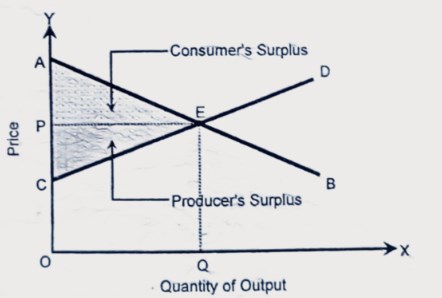
In the figure, X-axis represents quantity of output and y axis represents price. The downward sloping curve AB represents demand curve and upward sloping curve CD represents supply curve. These 2 curves are intersecting each other at point E, which is the equilibrium point. Hence, equilibrium price is OP. and equilibrium quantity is OQ. In figure total surplus is shown by shaded area AEC. The area below demand curve and above equilibrium price , i.e area APE is the consumer’s surplus and the area below equilibrium price and above supply curve i.e area CPE is the producer’s surplus.
Consumer Surplus (C.S.) = APE & Producer Surplus (P.S.) = CPE.
Total Surplus = C.S. + P.S. = APE + CPE = AEC
Thus we can see that total surplus AEC is the maximum surplus received by all participants (i.e Buyers and Sellers) in the market transaction. This indicates that the market is efficient.
In summary, consumer surplus and producer surplus are important concepts in economics because they help us understand the benefits that consumers and producers receive in a market transaction. If the price of a good or service is set too high, then consumers may not be willing to purchase it, and the producer may not be able to sell it. On the other hand, if the price is set too low, then the producer may not be willing to supply it, and consumers may not be able to obtain it. When the price is set at the right level, however, both consumers and producers can benefit, and the market can operate efficiently.
Descriptive Numerical Answer Questions
Group C – Analytical Answer Questions
Chapterwise Notes in Q & A Format for Group C ( with TU Soln )
Possible Exam Q & A plus Past Exams Solution from this Group
Note: All possible question-topics that can be asked in this group are already discussed earlier in Group B. Therefore, relax now and move to the next lesson!

And yes, congratulations! You’ve now gone through every type of question that can be asked in your exams from this unit. A next round of revision will certainly help you learn & remember all these answers to your exam questions!